


As The Blue Room’s longest-serving team member, Bronya Vine shares three decades of memories, milestones, and moments that help define the history of 18th & Vine.
By:
For almost three decades, Bronya Vine has been a cornerstone of The Blue Room experience. From unforgettable celebrity encounters to witnessing the evolution of Kansas City’s historic 18th & Vine Jazz District, her story reflects the heart, history, and soul of the American Jazz Museum. This interview is part of the museum’s Oral History Project.
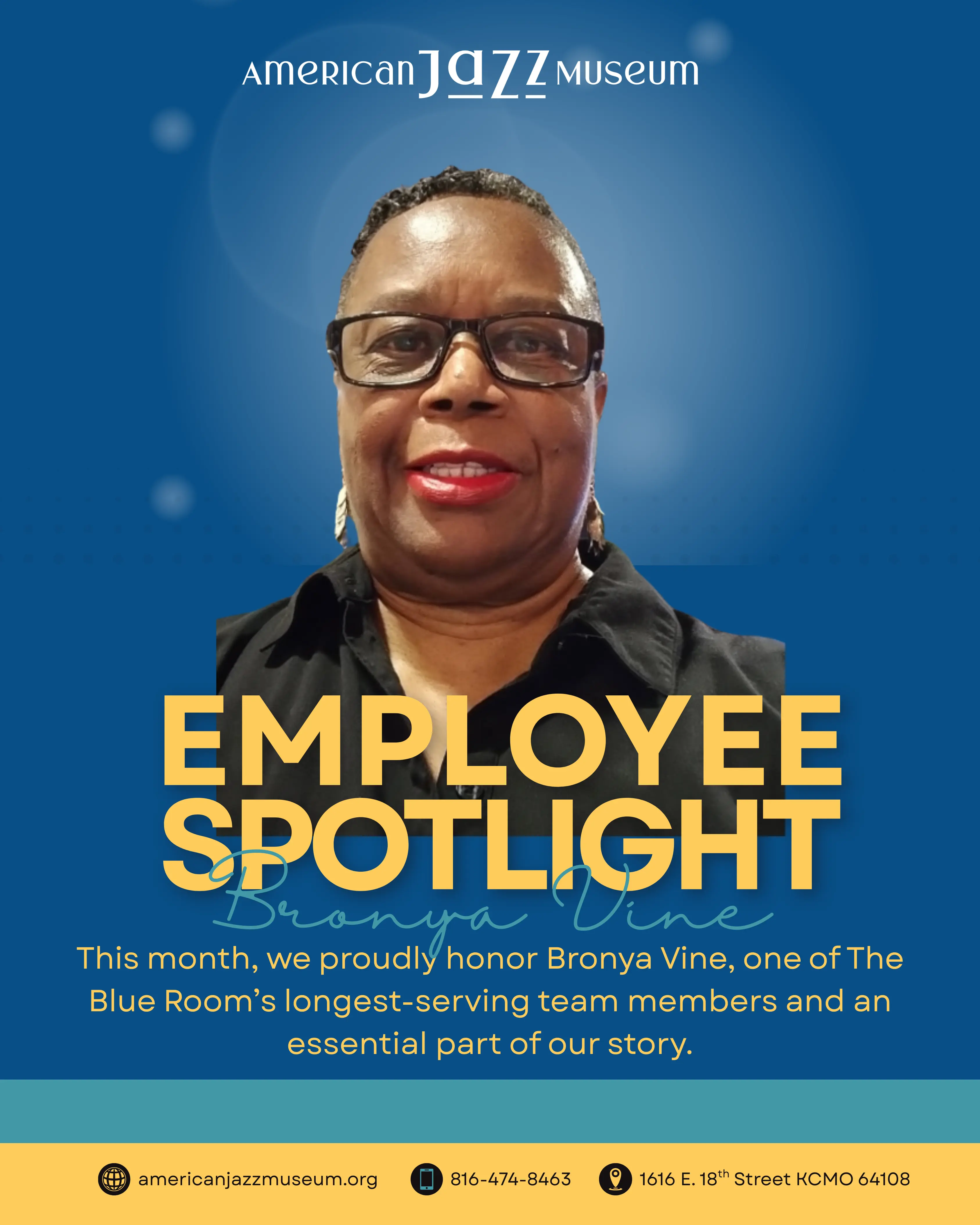
Joining The Blue Room in 1997
When asked how her journey began, Bronya’s answer is simple: “I joined The Blue Room on October 3rd, 1997. Andre hired me. Back then, the City didn’t own The Blue Room. It was contracted out, and every two years people would bid to run it.”
When management changed, she stayed—and has been here ever since. What began as a server position has grown into a nearly 30-year legacy.
A Server, a Storyteller, and a Steady Presence
Bronya was originally hired as a server but soon found herself helping with bartending and special events. Over the years, she gravitated back to serving, where her consistency and skill shine most.
“I’m good at my job, and they like that. That’s where I’m most needed.”
Her warmth and professionalism have become part of The Blue Room’s fabric.
Her Most Unforgettable Night: The Night Prince Walked In
Of all her memories, one stands above the rest: the night Prince visited The Blue Room.
“It was a Monday Night Jam. Prince had a concert downtown the next day, but he and his band came in. His band jammed with the musicians here. Just as he was coming to the stage, the electricity went out. They never turned the lights back on.”
Only one staff member was allowed into Prince’s private seating area—Bronya.
“Every chance I got, I checked on him. I asked for a picture, an autograph, and he just said, ‘No, baby, I don’t do that.’ But being right there with him? That was excellent. Prince is a legend.”
Keeping Her Energy Up: The Kombucha Ritual
Long nights require stamina, and Bronya swears by one ritual: “I drink kombucha. Every night we’re open, I bring one. It gives me a burst of energy when I get tired. I drink all the flavors. Synergy is the brand.”
How The Blue Room Has Evolved
While the venue has remained true to its roots, a few changes have shaped its modern feel:
- Pillars that once separated upper and lower seating were removed after guests complained about blocked views; they now line the East Wall.
- The iconic Blue Room sign above the stage was added later.
- Otherwise, the vibe has stayed classic, intimate, and uniquely Kansas City.
Friday Nights, Indigo Hour, and Crowd Favorites
Fridays are her longest and busiest shifts. “Indigo Hour starts at 5:00 PM, the main show at 5:30 PM. Before COVID, we stayed open until 1:00 AM. Now we close at 11:00 PM.”
Saturdays vary depending on who’s performing—regulars have their favorites.
The Blue Room OGs
With nearly three decades at the venue, Bronya is one of its longest-serving team members. When asked who else qualifies as an “OG,” she names a few standouts:
- Ronnie — “Everybody calls him ‘the mayor.’ He came shortly after I started and did an excellent job keeping the place up.”
- Gerald and Drew — Became more involved after the City took over operations and folded The Blue Room into the museum’s staffing structure.
Hopes for the Future of 18th & Vine
As new development continues across the district, Bronya has a clear vision for preserving The Blue Room’s identity.
“I would not turn it into a restaurant. Food grease and odors would destroy the historical artifacts. You can’t get that back.”
She also believes the long-discussed idea of uniting two cultural pillars is overdue: “The Negro Leagues Baseball Museum and the American Jazz Museum should merge. When the Monarchs played and Satchel Paige pitched—jazz was happening too. It’s all Black history.”
Gratitude, Growth, and God’s Grace
When reflecting on her years of service, Bronya’s gratitude is front and center: “God has blessed me. I owe everything to Him—the time I’ve had here, the people who believed in me, the strength to do this work.”
She speaks proudly of the team’s dedication, especially during short-handed nights, and of how much effort goes into making every guest feel welcome.
“This job keeps me sharp. It teaches you to multitask and to be patient. I didn’t have patience when I started, but I’ve learned.”
A Legacy of Service
The Blue Room remains one of Kansas City’s most iconic cultural spaces—and team members like Bronya Vine are a big part of the reason why.
Her passion, loyalty, and lived history enrich every night of music, every guest interaction, and every moment inside the venue.
The American Jazz Museum is proud to honor her commitment as we celebrate the past, present, and future of jazz on 18th & Vine.


